
Businesses everywhere are searching for smarter ways to display information without draining power or budgets. That’s where E Ink display solutions come in. Unlike LCD or LED screens, E Ink technology requires virtually no power to maintain an image on the screen. It remains visible in strong light and can operate for months from a single charge.
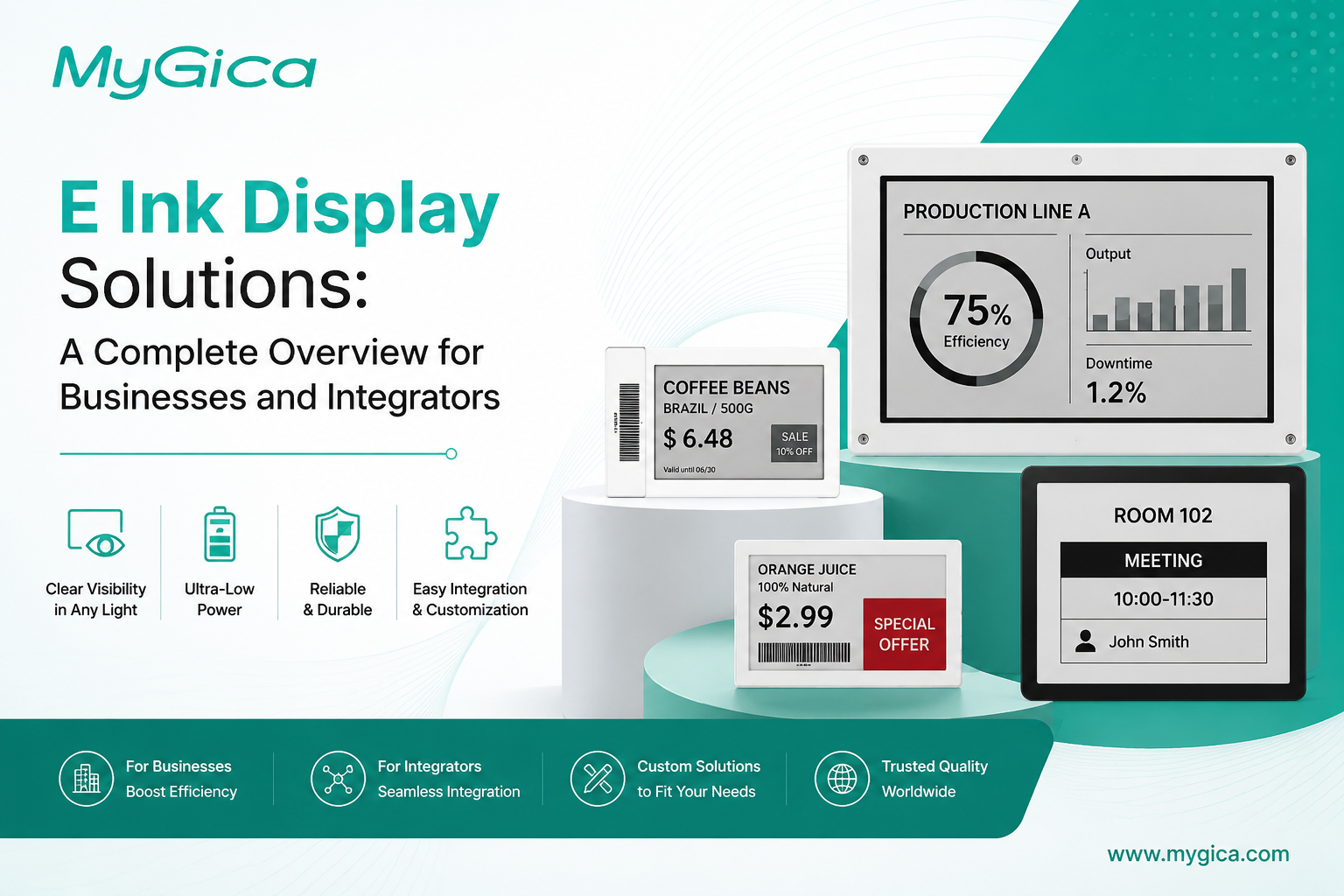
This makes it suitable for retail stores, distribution centers, hospitals, and smart city projects. This guide will tell you what E Ink display solutions are, where they’re best suited, and what you need to look for before you select a supplier.
What Are E Ink Display Solutions?
E Ink is also known as electronic paper or e-paper, a display technology that is virtually a digital version of ink on paper. It reflects the surrounding light to show the image, just as a printed paper does.
This makes it different from LCD and LED screens that depend on the backlighting feature to create the pictures. A backlit screen continues to be on, consuming energy even when the screen content is not changing.
Compared to the other display technologies that keep using energy even when the image remains the same, E Ink only uses power when the display changes. Once a picture is shown on the screen, it stays without consumption of power. This is why more companies are adopting E Ink display systems for labels, signs, and information panels.
How E Ink Technology Works
E Ink screens are made up of millions of tiny microcapsules, each about the width of a human hair.
These microcapsules contain black and white pigment particles suspended in a clear fluid.
When an electric charge is applied, the pigment particles move to the top or bottom of the capsule, forming black or white pixels. The process is quite similar to positioning small magnets.
Once power is disconnected, the pigment particles don’t move from their positions. So, the display holds the image for a long time with very little energy usage.
Types of E Ink Displays
- Black & White Displays: Ideal for basic text like signage and shelf labels.
- Grayscale Displays: This provides greater contrast levels, ideal for product information displays.
- Promotional signage and retail tags in any brand color are now available with the use of Col E Ink.
- Bendable Displays: Flexible without breaking, useful for curved surfaces or wearables.
- Large Format Displays: Designed for wayfinding, transit, and public information signs.
- Touch-Enabled Display: Enable interaction (useful in kiosks and healthcare check-in systems).
Key Benefits of E Ink Display Solutions
- It consumes low power, which means that it can run for weeks or months on a single charge, thereby reducing energy costs significantly.
- E Ink screens are readable in all lighting conditions, while LCD displays tend to become dull in the sun.
- Long battery life means less maintenance and less labor for battery replacement.
- The paper-style, flicker-free display is easy on the eyes, helping to minimize fatigue.
- This also contributes to sustainability as it indicates reduced power consumption, which is also translated to carbon footprint.
- Wireless enables content to be pushed to devices over a wide area network.
- Low maintenance and long life in the years lead to reduced total cost of ownership.
Common Business Applications
- Retail: E-shelf labels allow prices on merchandise to update instantly, eliminating the labor of changing physical tags.
- Warehousing & Logistics: Labels and tracking tags placed in bins remain durable and readable in low-light environments.
- Healthcare: Signage for patients and their relatives showing room numbers and directions can stay updated without requiring frequent recharging.
- Transportation: Signs placed at public transport stops and stations display schedules while using very little power.
- Smart & Eco Offices/Conferences: These eco-friendly devices, such as desk labels and meeting room signs, help save paper and reduce waste.
- Education/University: These electronic notice boards have replaced printed timetables and announcements.
- Smart City: Solar- or battery-powered city information kiosks with public display screens are now being used extensively.
- Factory/Industries: Equipment status boards provide useful, real-time details to staff in manufacturing plants.
E Ink vs LCD vs LED Displays
| Feature | E Ink | LCD | LED |
| Power Usage | Very low | High | High |
| Outdoor Visibility | Excellent | Poor (glare) | Moderate |
| Refresh Speed | Slow | Fast | Fast |
| Battery Life | Weeks to months | Hours | Hours |
| Maintenance | Low | Moderate | Moderate |
| Best Use | Static/updating info | Video, dynamic content | Bright ads, video |
| Lifespan | Long | Moderate | Moderate |
Factors to Consider Before Choosing an E Ink Display Solution
Begin by choosing the size and resolution of the display depending on the information that will be presented. Check connectivity options like Wi-Fi, Bluetooth, or NFC for remote updates.
Check API compatibility with existing software systems. Consider durability and environmental ratings if the display will be used outdoors or in harsh conditions.
Check power consumption, update frequency, and industry certifications. Last but not least, verify warranty terms, scalability, and after-sales support with the supplier before signing.
Integration Considerations for OEMs and System Integrators
For OEMs and system integrators, hardware compatibility is just as important as the display itself. Make sure that the display functions with your current controllers and controller software.
The integration of software should be easy and user-friendly, providing clear APIs and documentation. Cloud connectivity enables centralized content management of hundreds of devices.
Inquire about wireless communication protocols like Bluetooth and Wi-Fi, as they can influence installation flexibility. Customization options, like screen size and casing, help match your product line.
Last but not least, ensure that firmware support and maintenance are available for the years to come, keeping your deployed devices reliable.
Future Trends in E Ink Display Solutions
Color E Ink technology is advancing rapidly, creating new possibilities for retail signage and packaging. Flexible displays are becoming more durable, making curved and wearable displays possible.
AI tools will increasingly tailor display content automatically based on data patterns. IoT integration is about embedding E Ink devices in larger smart building and smart city networks.
Businesses are shifting to sustainable digital signage as they seek to cut down on their energy consumption. In the near future, the technology is expected to see increasing adoption in smart logistics, smart healthcare, and public infrastructure.
Conclusion
E Ink display solutions offer a rare combination: low power use, excellent readability, and long-term cost savings. This technology addresses genuine issues for OEMs, integrators, and enterprise buyers in retail, logistics, healthcare, and other sectors.
It all depends on the right partner. With years of experience in the industry, MyGica offers businesses around the world reliable e-paper and E Ink display solutions, boasting excellent hardware compatibility, quick response times, and scalable options for OEMs and integrators alike.
If you’re ready to dive into the world of E Ink display solutions, MyGica is a trusted partner to help you get started.
FAQs
1. What is an E Ink display used for?
E Ink displays are commonly used for signage, shelf labels, and information boards. They are most effective when the content changes periodically, rather than frequently.
2. Is E Ink better than LCD for outdoor use?
Yes, E Ink is much more readable in sunlight than LCDs. LCD screens can be difficult to read outdoors due to glare and washout.
3. How long does an E Ink display battery last?
The battery lasts from weeks to months, depending on how often the display content is updated. This makes E Ink perfect for wireless and hassle-free operation.
4. Can E Ink displays show color?
Yes, color E Ink technology exists and is improving rapidly. More and more, it’s being employed on signage and promotional displays in retail spaces.