
Compare two e-paper modules with nearly identical panel specs, and it’s easy to assume they’ll behave the same way. In practice, one refreshes cleanly and the other ghosts, lags, or picks up interference in the field — and the panel usually isn’t why. The interface connecting your MCU or SoC to the TCON, and the TCON to the panel itself, has more influence over real-world performance than most datasheets let on.
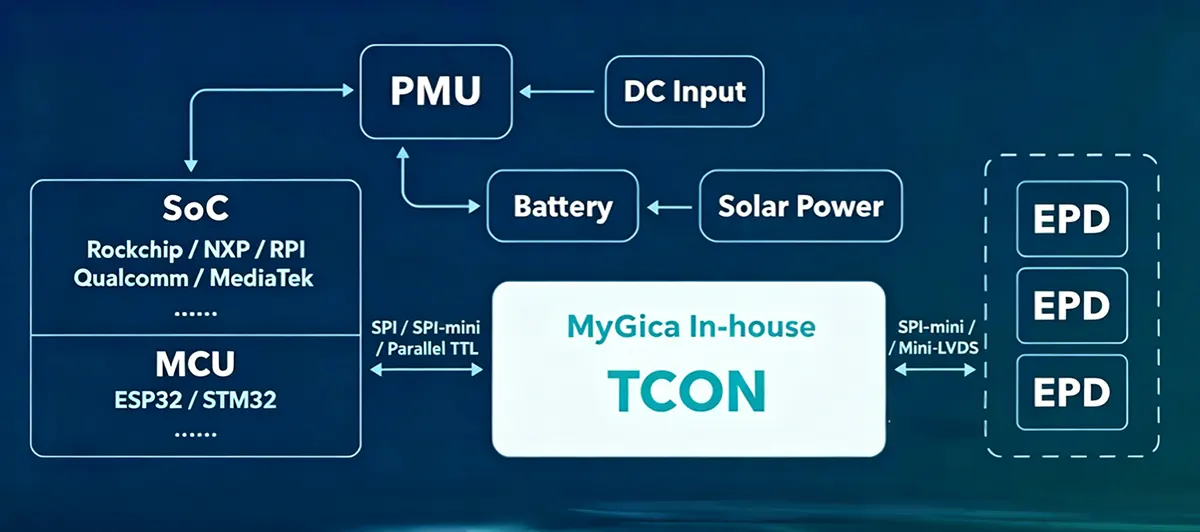
It’s worth being precise about which link is actually being discussed, since “interface” gets used loosely for two different connections in the signal chain:
- MCU/SoC → TCON: typically SPI, or parallel TTL.
- TCON → e-paper panel: typically SPI or mini-LVDS.
These aren’t always the same interface on both ends of a design, and conflating them is a common source of confusion when comparing modules or writing a spec. This piece covers the data interfaces specifically — SPI, parallel TTL, and mini-LVDS; control/status channels like I²C are a separate topic.
1. Matching the Interface to the Application
Not every project needs the same interface, and picking the “best” one in the abstract isn’t the goal — matching it to your actual panel size and use case is. As a starting reference:
- SPI — the default choice for small-to-mid panels and cost-sensitive designs. Nearly every MCU supports it natively, tooling is universal, and it’s the lowest-friction path for a straightforward embedded project.
- Parallel TTL — moves more bits per clock cycle than serial SPI, at the cost of pin count. Reasonable for mid-size panels on short board-to-board or short-cable connections where the extra throughput is worth the routing complexity.
- Mini-LVDS — the panel-side interface for larger, higher-resolution displays, or any design where the TCON-to-panel run is longer than a few centimeters. Differential signaling gives it real bandwidth and noise-immunity advantages the single-ended options don’t have.
2. Bandwidth, Refresh Speed, and Resolution
This is usually where interface choice first becomes a real constraint rather than a preference. Bandwidth requirements scale with panel resolution and how fast you need a frame to move across the interface. On a small, low-resolution panel with infrequent updates, SPI’s serial, bit-by-bit transfer is a non-issue. On a large, high-resolution panel — particularly one expected to support fast or partial refresh — serial transfer time starts to matter, and parallel or mini-LVDS interfaces earn their added complexity by moving more data per clock cycle or sustaining a higher clock rate reliably.
One caveat worth flagging directly: interface bandwidth is necessary but not sufficient for fast refresh. The TCON’s own waveform and driving capability — covered in our TCON board explainer — is an equal factor. A fast interface feeding a TCON without strong partial-refresh driving logic won’t get you fast, clean updates on its own.
3. Host/TCON-Side Resources and Integration Difficulty
The practical question for a board designer isn’t “which interface is technically best” — it’s “what does this cost me in pins, routing, and MCU capability, on the board I’m actually laying out.”
SPI ask the least of the host — minimal GPIO count, supported by essentially any MCU including lightweight, low-cost parts, which is why they pair naturally with compact or IoT-style designs. Parallel interfaces need considerably more GPIO from the host and more board routing, in exchange for higher per-cycle throughput. Mini-LVDS is the most demanding on paper — but the integration burden doesn’t have to land on your host MCU/SoC at all. A well-designed TCON board can bridge this itself: expose a simple interface (SPI or even USB) to the host, and handle the conversion to mini-LVDS internally on the way to the panel. Worth confirming explicitly which side of that bridge any TCON board you’re evaluating actually puts the complexity on, since not every vendor’s implementation works this way — some genuinely do require native LVDS support on the host side, which is a meaningfully higher integration bar.
4. EMI, Line Length, and Reliability
This one tends to show up late — often after a prototype that worked fine on the bench starts glitching once it’s in a real enclosure with longer cable runs. The single-ended vs. differential distinction is why. SPI and parallel TTL are all single-ended signaling — fine over short runs, but increasingly vulnerable to EMI as cable length or clock speed goes up. Mini-LVDS’s differential signaling gives it real noise immunity, which is why it’s the standard choice for longer TCON-to-panel runs, larger enclosures, and industrial or outdoor deployments where electrical noise is a real factor — see our outdoor e-paper display guide for the broader environmental considerations that compound this on large outdoor signage specifically. If your panel-side cable run is longer than a few centimeters, or the deployment environment is electrically noisy, mini-LVDS is worth defaulting to rather than pushing SPI past its comfortable range.
5. Protocol, Command Set, and Debugging
Worth thinking about before you commit, not after: how painful is this actually going to be to bring up and troubleshoot? SPI is the easiest of these to debug by a wide margin — it’s universally documented, every logic analyzer and scope handles it natively, and the driver/library ecosystem is enormous. Parallel TTL is still straightforward to probe (each line is a simple digital signal), but you need more channels captured simultaneously to make sense of it. Mini-LVDS is the most specialized: differential probing requires the right analyzer, command sets tend to be more vendor-specific, and you’ll generally lean on the TCON vendor’s own documentation and support more than you would debugging a generic SPI link. Budget debug time accordingly — this is a real, if often underestimated, project cost.
6. Impact on BOM and Cost
Interface choice cascades further into the bill of materials than it first appears. SPI keep connector count and PCB routing simple, and they’re compatible with cheaper MCUs — a compounding cost advantage for high-volume, cost-sensitive designs. Parallel interfaces add connector and layout cost for the pin count alone. Mini-LVDS typically requires a more capable (and more expensive) SoC or a bridging chip, plus higher-spec cabling and connectors for the differential pairs — a real cost premium, justified specifically when bandwidth or reliability at larger panel sizes actually requires it, not as a default choice.
Quick Reference
| Interface | Best Fit | Integration Difficulty | EMI/Line-Length Tolerance | Relative Cost |
|---|---|---|---|---|
| SPI | Small–mid panels, cost-sensitive designs | Low | Short runs only | Lowest |
| Parallel TTL | Mid-size panels, short board-to-board links | Moderate | Short runs only | Moderate |
| Mini-LVDS | Large/high-res panels, longer cable runs, noisy environments | High (unless bridged on-board) | Strong (differential) | Highest |
Reference Controller Platforms and TCON Solutions
Translating the above into actual boards, MyGica’s controller and TCON lineup spans this same range:
| Platform | Role | Positioned For |
|---|---|---|
| TCON-SPI | TCON board | 10″ E Ink Spectra 6 panels; SPI/USB host interface; the standard entry point for MCU-driven, small-panel designs |
| TCON-SPI-Mini | TCON board | 10″ E Ink Spectra 6 panels; SPI-only host interface; a more compact, lower-BOM variant of TCON-SPI for pin- and cost-constrained designs |
| TCON-MiniLVDS | TCON board | 25.3″, 28.5″, 31.5″ and larger panels; USB host interface, with mini-LVDS/TTL handled on the panel side by the board itself — no native LVDS support required on the host |
| EPC-ESP32 | Integrated controller | Built on Espressif ESP32-S3 (RTOS); a lightweight, low-power control platform suited to compact, battery-oriented, or IoT-style designs |
| EPC3566 | Integrated controller | Built on Rockchip RK3566 (Linux/Android); a full-OS commercial signage platform for 13.3″/31.5″ E6 panels, where app-level functionality or a longer product lifecycle commitment matters |
Which of these fits depends on the same factors covered above: target panel size, refresh requirements, how much integration complexity you want to own on your own board versus offload to the controller/TCON board itself, and where the design sits on the cost curve.
FAQ
Does choosing mini-LVDS always mean my host MCU needs native LVDS support?
Not necessarily — it depends on how the TCON board is designed. Some TCON boards expose a simple host interface (like SPI or USB) and handle the mini-LVDS conversion internally on the way to the panel; others genuinely require native LVDS output from the host. Confirm which architecture a given TCON board uses before assuming either way.
Do I need mini-LVDS for every large e-paper panel?
Not strictly by size alone — it depends on required refresh speed, cable length between the TCON and panel, and the electrical environment. A large panel with a very short, well-shielded connection and modest refresh requirements may still work over SPI or parallel; mini-LVDS becomes the clear choice once cable length, speed, or noise immunity actually demand it.
Which interface is easiest to debug during development?
SPI, by a clear margin — universal tooling, extensive documentation, and a large existing driver ecosystem make it the fastest to bring up and troubleshoot. Mini-LVDS generally requires more specialized equipment and closer reliance on the TCON vendor’s own documentation.