
Most sourcing problems aren’t discovered at the factory. They’re discovered months later, when a batch arrives and doesn’t match the sample, or when a shipment gets held at customs over a classification issue nobody flagged in advance. Both are avoidable — but only if you know where to look before you commit.
China remains the center of gravity for e-paper manufacturing, and for good reason — dense supplier networks, mature component supply chains, and production capacity that’s genuinely hard to match elsewhere. That doesn’t mean the process is risk-free. Most of the real risk isn’t exotic; it shows up in a handful of well-documented, recurring places.
Why China?
It’s worth being specific about this rather than treating it as a given. A few concrete factors explain why China remains the default starting point for e-paper sourcing specifically, not just electronics generally:
- Component proximity. The panel supply chain, driver electronics, connectivity modules, and enclosure manufacturing are concentrated within a relatively small geographic radius — mainly the Guangdong industrial clusters — which shortens iteration cycles between design changes and physical samples.
- Manufacturing scale. Production capacity built for consumer electronics generally (displays, batteries, PCBAs) carries over directly to e-paper hardware, which is a smaller-volume category that benefits from infrastructure built for much larger ones.
- Established e-paper-specific expertise. Beyond general electronics capability, there’s a meaningful concentration of suppliers with specific experience integrating E Ink and other reflective-display panels — a narrower skill set than general PCB assembly.
None of this eliminates the risks below — it just explains why “source elsewhere entirely” often isn’t a realistic default for this specific product category, even for buyers actively diversifying other parts of their supply chain.
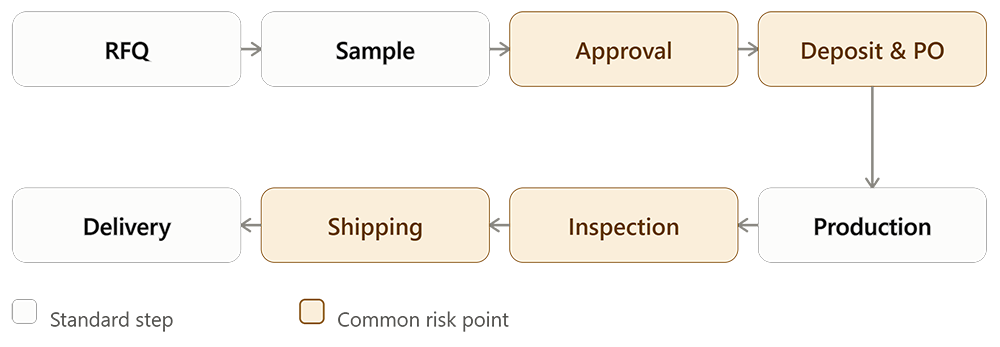
The Process, at a High Level
A typical e-paper sourcing project moves through: RFQ and technical spec exchange → sample production and approval → deposit and purchase order → mass production → quality inspection → shipping and customs clearance → delivery. The risks below map onto specific points in that sequence — worth keeping in mind, since “where in the process something goes wrong” often determines how expensive it is to fix.
Risk 1: You’re Sourcing from a Trading Company, Not a Factory
This is the most foundational risk, and it colors most of what follows — if you’re not actually dealing with the manufacturer, your visibility into production, your ability to escalate quality issues, and your leverage on timelines are all one step removed. We’ve covered how to verify this directly in our guide to choosing a reliable e-paper display supplier; it’s worth resolving before any of the steps below, since a trading company can’t actually guarantee most of what comes next.
Risk 2: The Sample Looks Great. Mass Production Doesn’t Match It.
This is one of the most consistently reported failure points in China sourcing generally, and it applies directly to e-paper: samples are often built carefully, sometimes by more skilled hands, under conditions that don’t scale to a production run. Materials, labor, and time pressure all shift once an order moves to volume, and defects that weren’t visible in a small sample batch can show up once production scales — inconsistent panel performance, enclosure fit issues, or firmware behavior that wasn’t fully tested at volume.
How to reduce this risk: Keep a physical “golden sample” against which production units can be directly compared, not just a spec sheet. Use third-party quality inspection during production (not just before shipment) rather than relying solely on the factory’s own QC sign-off. For larger orders, an in-process inspection partway through the run catches problems while there’s still time to correct them — waiting until a pre-shipment inspection on a finished batch means any systemic issue has already affected the whole order.
Risk 3: Specifications Get Lost in Translation — Even in English
Even when communication happens entirely in English, small gaps in how a spec is written can lead to real differences in what gets built. “IP65-rated enclosure” and “IP65-rated enclosure, tested per IEC 60529” aren’t the same instruction to a factory, and the gap between them isn’t always obvious until a unit fails a test it was never actually verified against.
How to reduce this risk: Put critical specs in writing with enough precision that they can’t be reasonably interpreted more than one way — reference test standards where relevant, not just target outcomes, and confirm in writing (not just verbally) that the factory has acknowledged each critical spec before production starts.
Risk 4: Payment Structure Doesn’t Match Your Actual Leverage
A typical structure is a deposit (commonly around 30%) before production, with the balance due before shipment or on presentation of shipping documents. The risk isn’t the structure itself — it’s paying the balance before confirming the goods actually match what was ordered, which removes your only real point of leverage if something’s wrong.
How to reduce this risk: Tie payment milestones to inspection checkpoints, not just production stages — for example, releasing final payment after a passed pre-shipment inspection rather than automatically at “production complete.”
Risk 5: IP and Tooling Ownership Isn’t Clearly Defined
For any project involving custom tooling, molds, or firmware — see our guide to what’s actually customizable on an e-paper display — ownership of that tooling and any custom design work needs to be explicit in writing. Without it, disputes over who owns a mold, or whether a factory can reuse a custom design for another client, tend to surface later rather than earlier, when they’re harder to resolve.
Risk 6: Tariffs and Customs Classification
This is the risk most likely to change between when you read this and when you place an order. Tariff treatment of electronics imported from China — including displays and display assemblies — currently involves multiple layers (a base MFN rate, Section 301 duties, and additional surcharges that have shifted more than once in the past two years), and the applicable rate depends on the exact HTS classification of the finished product, not just the general product category. Rules around duty-free thresholds for low-value shipments have also changed recently, so assumptions based on older sourcing experience may no longer hold.
This is genuinely not a topic to plan around from a blog post — rates, exclusions, and thresholds have been actively moving, and the cost difference between a correct and incorrect HTS classification can be substantial at any real volume. Confirm current rates and classification with a licensed customs broker for your specific product and destination market before finalizing landed-cost calculations, and revisit that confirmation periodically rather than assuming a quote from six months ago still holds.
Risk 7: Shipping Terms Shift More Risk to You Than You Realize
FOB (Free on Board), EXW (Ex Works), and DDP (Delivered Duty Paid) shift responsibility for freight, insurance, and customs clearance at different points — and the terms quoted by a factory aren’t always the terms that minimize your actual risk. EXW in particular puts more logistics responsibility on the buyer than many first-time importers expect.
How to reduce this risk: Understand exactly which party is responsible for each stage of transit before agreeing to terms, and consider working with a freight forwarder who can advise on which incoterm actually fits your experience level and risk tolerance, rather than defaulting to whatever the factory quotes first.
A Practical Checklist Before You Commit
- Confirmed you’re dealing with the actual manufacturer, not an unverified reseller
- Retained a physical golden sample tied to written spec sign-off
- Arranged third-party inspection during production, not just before shipment
- Structured payment milestones around inspection checkpoints
- Documented tooling and IP ownership in writing before custom work begins
- Confirmed current tariff classification and rate with a customs broker
- Understood which incoterm you’re actually agreeing to, and what it means for your liability
FAQ
Is it safe to pay a 100% deposit to a Chinese e-paper manufacturer? It’s generally not advisable, regardless of how reputable the supplier appears. A staged payment structure tied to production and inspection milestones gives you leverage to address problems before all funds have changed hands.
How do I know if a quoted price already accounts for current tariffs? Ask directly whether the quote is FOB (which typically excludes destination-country duties) or a landed-cost figure that includes them — and confirm the current applicable rate independently with a customs broker, since tariff rates on electronics from China have changed more than once recently and a supplier’s quote may not reflect the most current rate.
What’s the difference between a pre-shipment inspection and an in-process inspection? A pre-shipment inspection checks a finished batch right before it ships — useful, but any systemic problem has already affected the whole order by that point. An in-process inspection happens partway through production, catching issues while there’s still time to correct the remaining run.
Do I need a lawyer to review a sourcing agreement with a Chinese manufacturer? For any order involving custom tooling, significant volume, or IP considerations, having a contract reviewed by someone with China sourcing and trade law experience is generally worth the cost relative to the risk it addresses — this guide covers what to watch for operationally, not legal or tax advice specific to your situation.
If you’re evaluating MyGica specifically against this checklist, our e-paper product line and OEM quotation checklist are a reasonable next step.