
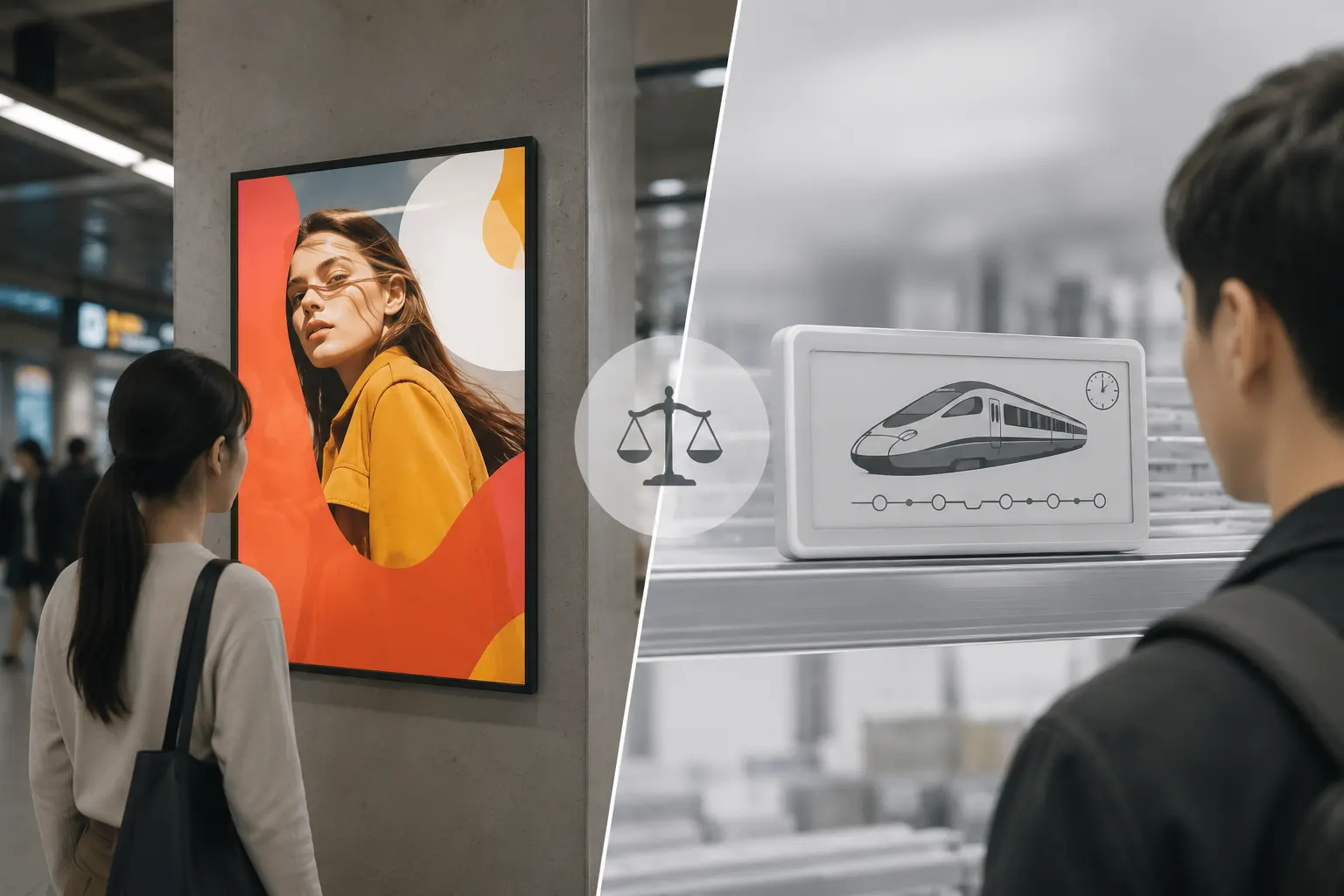
E-paper displays are increasingly replacing printed posters and traditional signage in retail and transportation settings because they combine near-zero power consumption with high readability in any lighting condition. Unlike backlit digital signage, e-paper looks and reads like ink on paper — but it can be updated remotely in seconds, without a single reprint.
For businesses weighing whether to stick with printed materials or move to e-paper, the decision usually comes down to three factors: how often content needs to change, where the signage is deployed, and what it costs to maintain over time. This guide breaks down all three.
E-Paper vs Printed Posters: Key Differences
| Factor | E-Paper Display | Printed Poster |
|---|---|---|
| Update cost | Remote digital update, no reprint | Reprint + physical replacement labor |
| Visibility | Consistent readability in direct sunlight and indoors | Fades and weathers over time |
| Power | Near-zero power, battery or solar capable | None needed, but no dynamic content |
| Content flexibility | Real-time or scheduled content updates | Static until physically replaced |
| Durability | Weather- and UV-resistant options available | Degrades with sun exposure and moisture |
| Long-term cost | Higher upfront hardware cost, lower cost per update | Low upfront cost, recurring reprint expense |
The core trade-off is upfront investment versus operating cost. A poster is cheap to print once. But every price change, promotion, schedule update, or seasonal campaign means another print run, another delivery, and another person physically swapping it out. E-paper shifts that cost from “every update” to “one-time hardware,” which is why the economics favor e-paper wherever content changes more than a few times a year.
E-Paper for Transportation Signage
Transportation signage has specific requirements that printed posters and standard digital displays both struggle with: exposure to weather, limited or no access to grid power, and the need for information to stay legible at a glance, day or night.
E-paper fits this environment for a few concrete reasons:
- Off-grid and solar-friendly. Because e-paper only draws power when the displayed content changes, a small solar panel and battery can keep a sign running indefinitely — no trenching for electrical conduit, no dependency on grid access. This is what makes e-paper practical for bus stops, rural transit shelters, and roadside signage far from existing infrastructure.
- Readable in direct sunlight. Reflective e-paper technology uses ambient light instead of a backlight, so it doesn’t wash out or glare in full sun — a common failure point for LCD-based transit displays.
- Withstands temperature swings. Outdoor transit signage needs to operate reliably from summer heat to winter cold; e-paper hardware built for outdoor deployment is designed around this range, unlike printed materials that warp, fade, or peel.
- Instant schedule updates. Route changes, delays, and service alerts can be pushed remotely across an entire network of signs at once, without dispatching a crew to physically replace printed schedules at every stop.
Typical transportation applications include:
- Bus stop and shelter schedule displays
- Rail and subway platform information boards
- Airport gate and wayfinding signage
- Parking guidance and availability signs
For a deeper look at solar-powered, fully off-grid transit deployments — including power budgeting and hardware considerations — see our guide on off-grid e-paper transit signage.
E-Paper for Retail Signage
Retail environments have a different priority: frequent content changes at low cost, without sacrificing shelf-level or window-level visual quality.
Common retail use cases include:
- Electronic shelf labels and price tags
- In-store promotional signage and window displays
- Directory and wayfinding signs in malls and shopping centers
- Menu boards for quick-service and hospitality settings
The core advantage in retail is update frequency. A store running weekly promotions or dynamic pricing can push changes to every sign from a central system, instead of reprinting and manually replacing paper tags and posters store by store.
Looking for a complete retail signage solution? Explore our Retail & Advertising Solutions page for product recommendations and deployment options tailored to retail environments.
Total Cost of Ownership: E-Paper vs Posters
The upfront cost of e-paper hardware is higher than a printed poster. But total cost of ownership depends on how often content changes over the sign’s lifetime.
Consider a sign that needs updating monthly:
- Printed poster: Each update requires a new print, plus the labor to remove the old poster and install the new one. Over several years, this recurring cost compounds — especially across a network of many locations.
- E-paper display: The hardware is purchased once. Updates after that are digital — no print cost, no travel, no labor for physical replacement, and no waste from discarded printed materials.
The break-even point depends on update frequency and network size, but as a general rule: the more locations you manage and the more often content changes, the faster e-paper pays for itself. Signage that rarely changes (a permanent storefront sign, for example) may not benefit as much — that’s where a printed sign can still make sense.
Frequently Asked Questions
Is e-paper better than posters for outdoor advertising? For outdoor advertising that needs to change periodically — promotions, pricing, seasonal campaigns — e-paper is generally more cost-effective over time because it eliminates reprinting and physical replacement. For signage that never changes, a printed poster can still be the simpler, lower-cost option.
How long does an e-paper sign last without power? Because e-paper only consumes power when the displayed image changes, a battery-powered e-paper sign can run for months between charges, and solar-powered installations can operate indefinitely without ever connecting to the grid. Actual runtime depends on update frequency and display size.
Can e-paper displays work in transportation environments like extreme heat, cold, or vibration? Yes. E-paper displays designed for outdoor and transportation deployment are built to operate across wide temperature ranges and are housed in weather- and impact-resistant enclosures suited to bus stops, rail platforms, and roadside installations.
Do e-paper displays require an internet connection to update? Most commercial e-paper signage systems support remote updates over Wi-Fi, cellular, or scheduled offline updates, depending on the deployment. This allows content to be managed centrally across a network of signs rather than updated one by one.
Ready to move from printed signage to e-paper? Contact MyGica to discuss the right display and deployment approach for your retail or transportation project.