
Many product teams underestimate the impact of display power consumption during early system design. It is often treated as a UI component, yet in real deployments it frequently becomes one of the dominant contributors to system power budget.
In battery-powered devices, digital signage, industrial measurement systems, and unattended field terminals, visual performance is rarely the primary constraint. System feasibility is.
The real question is simple:
How long can this device operate reliably under a fixed energy budget?
E-Paper removes the display from a device’s steady-state power budget entirely — it draws power only when content changes, and holds an image indefinitely without it. LCD keeps the display active continuously, regardless of whether content is static. For power-constrained, low-frequency-update systems, that architectural difference usually outweighs LCD’s lower unit cost and faster refresh; for systems needing continuous interaction or real-time content, the reverse is true.
E-Paper and LCD are the two most commonly considered display technologies in this space. However, they are not variations of the same approach — and if you’re also weighing E-Paper against E Ink specifically as terms, see our E Paper vs E Ink explainer first. E-Paper and LCD are fundamentally different in how they consume power, maintain state, and interact with system architecture.
This article focuses on practical selection trade-offs rather than specification comparisons.
Power Consumption: Continuous Load vs Event-Based Energy
Power behavior is often the first filter in display selection.
The difference between E-Paper and LCD is not incremental efficiency—it is system-level power architecture.
E-Paper is based on a bistable display mechanism (see our e-paper glossary for a full breakdown of this and related terms). Once content is written, the display state is physically retained without requiring continuous electrical input. Power is only consumed during update cycles.
LCD behaves in the opposite way. It requires continuous backlight operation and constant drive signals to maintain visibility. Even when the screen is static, the power draw remains essentially unchanged.
This leads to a critical engineering implication:
E-Paper removes the display from the steady-state power budget. LCD keeps it permanently active.
In low-duty-cycle systems, this difference directly determines whether long-term battery operation is realistic or not.
Readability: Reflective Physics vs Emissive Illumination
Readability is not just a brightness parameter—it is defined by optical architecture.
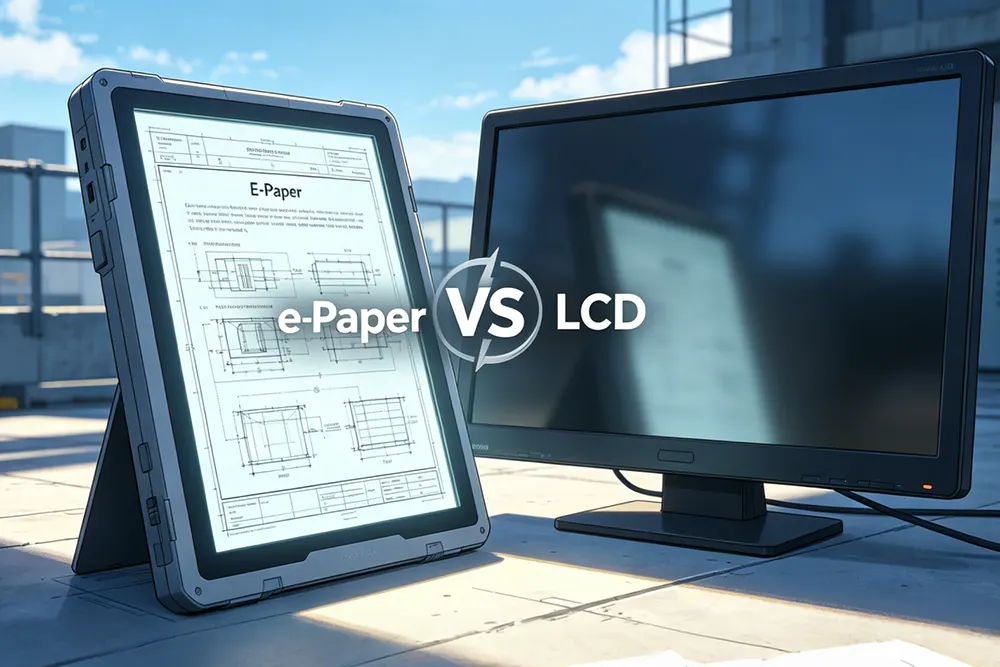
E-Paper uses a reflective principle. It does not emit light, but instead reflects ambient light to form visible content. As a result, readability improves under stronger environmental lighting. Direct sunlight is not a disadvantage—it becomes a source of contrast.
LCD relies on emissive backlighting. This works well in controlled lighting environments but becomes less effective under strong ambient light, where external illumination competes with the backlight.
To maintain readability outdoors, LCD systems typically increase backlight intensity. This improves visibility but introduces a direct trade-off: higher power consumption and increased thermal load.
In real system design, this trade-off is often unavoidable.
Refresh Performance: Interaction Model Defines Architecture
Refresh characteristics define how each technology fits into system behavior.
LCD is designed for continuous update environments. It supports real-time rendering, interactive interfaces, and high-frequency data refresh without structural limitations.
E-Paper is optimized for low-frequency updates. Refresh cycles are slower, and repeated updates are not its primary operating condition. It is best suited for stable or slowly changing information layers.
From an engineering perspective, this is not a performance gap—it is a workload mismatch.
- LCD aligns with dynamic systems
- E-Paper aligns with static or event-driven systems
Typical examples include sensor readings, status indicators, labels, and scheduled information displays.
Durability and System Integration
From a mechanical and system integration standpoint, the two technologies introduce different constraints.
E-Paper panels are lightweight and mechanically flexible, making them suitable for compact or constrained form factors. More importantly, their ultra-low power behavior reduces thermal stress, which improves long-term stability in sealed or remote deployments.
LCD technology benefits from a mature supply chain and wide availability across sizes and resolutions. However, its reliance on backlight modules introduces additional thermal considerations. Over long-term operation, heat accumulation and backlight aging become design factors that must be managed at system level.
In field deployments, this often translates into additional requirements for enclosure design, thermal paths, and power conditioning.
Cost: Component Price vs Lifecycle Energy
Cost evaluation for battery-powered or unattended displays is rarely accurate when limited to BOM-level comparison.
LCD typically offers lower upfront cost due to mature manufacturing scale and supply chain optimization. This makes it attractive for high-volume, cost-sensitive products.
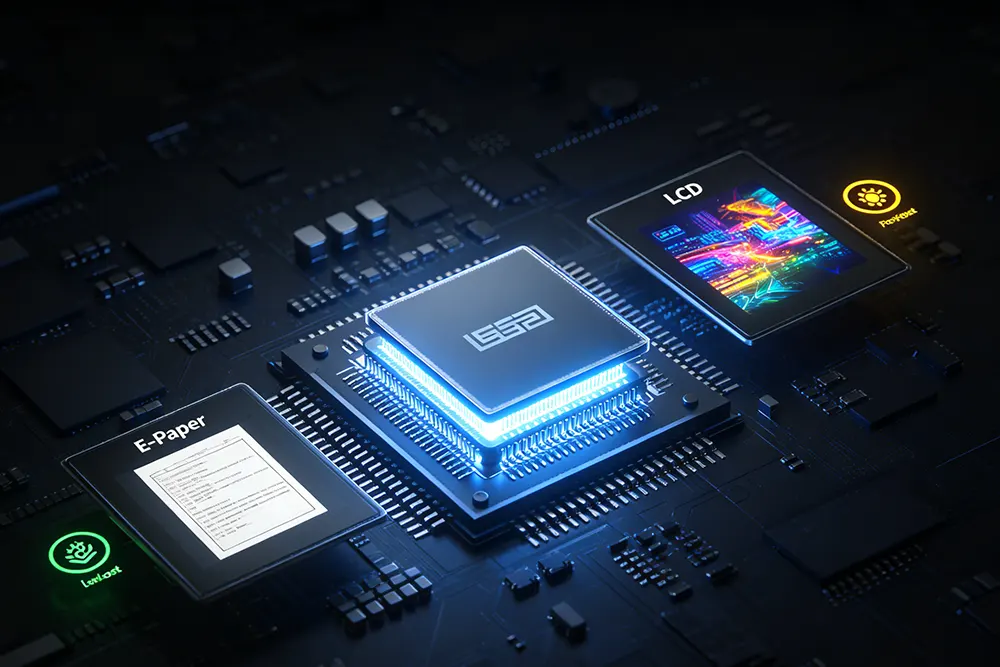
E-Paper has a higher unit cost, but its system-level energy profile changes the equation over time. Since power is only consumed during updates, total energy usage across the product lifecycle is significantly reduced.
In battery-powered or remote systems, this directly translates into:
- Reduced battery capacity requirements
- Lower maintenance frequency
- Extended unattended operation cycles
In long-life deployments, lifecycle cost often outweighs initial hardware savings.
Application Guidance: When Each Technology Makes Sense
E-Paper becomes the natural choice when system constraints prioritize energy efficiency over interaction complexity.
Typical use cases include:
- Battery-powered industrial measurement devices
- Battery- or solar-powered outdoor signage and wayfinding panels
- Static status indicators in field equipment
- Low-frequency update information terminals
In these scenarios, information stability is more important than visual dynamics.
LCD is preferred when continuous interaction or dynamic content is required.
Typical use cases include:
- Real-time monitoring dashboards
- Industrial control interfaces
- Consumer electronic displays
- Multimedia or interactive terminals
In these environments, stable power availability allows LCD’s continuous operation model to be fully utilized.
Engineering Selection Rule
A practical way to simplify selection is to evaluate system behavior first, not display characteristics.
If the system operates under strict power constraints or intermittent energy availability, E-Paper becomes the default option. For static, low-frequency-update deployments — the profile most teams land on here — MyGica’s Monochrome E-Paper Displays line is built specifically for this power-constrained use case.

If the system requires continuous updates and real-time interaction, LCD remains the practical solution.
When both requirements coexist, hybrid approaches or alternative technologies may need to be considered, but at the cost of increased system complexity.
Frequently Asked Questions
Does E-Paper really use zero power when the screen isn’t changing? Effectively yes. Because it’s bistable, an E-Paper display holds its last written image without continuous electrical input — power is only drawn during an update, not to maintain a static screen.
Is E-Paper too slow for any interactive use? It depends on the interaction. E-Paper isn’t suited to real-time or high-frequency updates, but for occasional user input — confirming a selection, paging through static content — the refresh delay is usually acceptable. Continuous or fast-changing interfaces still call for LCD.
Does E-Paper’s higher unit cost ever pay off? Usually in battery-powered or hard-to-access deployments. Lower lifecycle energy use can reduce battery size, extend replacement intervals, and cut maintenance visits enough to offset the higher panel price — the longer and more remote the deployment, the stronger that case becomes.
Conclusion
E-Paper and LCD are not interchangeable display technologies. They represent fundamentally different design philosophies.
E-Paper is optimized for energy minimization and persistent static information. LCD is optimized for continuous interaction and dynamic visual output.
When choosing a display for a power-constrained deployment, the key is not picking the “better” technology, but selecting the one that matches how the content actually behaves — static and infrequent, or continuous and dynamic.
Once this distinction is clear, display selection becomes a deliberate design decision rather than a component-level compromise. To see how this plays out across real digital signage deployments, E-Paper Digital Signage: Real-World Use Cases is a good next read.