
If you’ve already decided e-paper is the right category for your product or signage — because you need low power and sunlight readability — the next decision trips up a lot of buyers: EPD or ChLCD? On a spec sheet they can look almost interchangeable. Both are reflective, both are bistable, both get marketed as “e-paper.” But they solve for different priorities, and picking one based on marketing language instead of your actual constraints — refresh frequency, operating temperature, color requirements — is a common way to end up redesigning a signage line six months in.
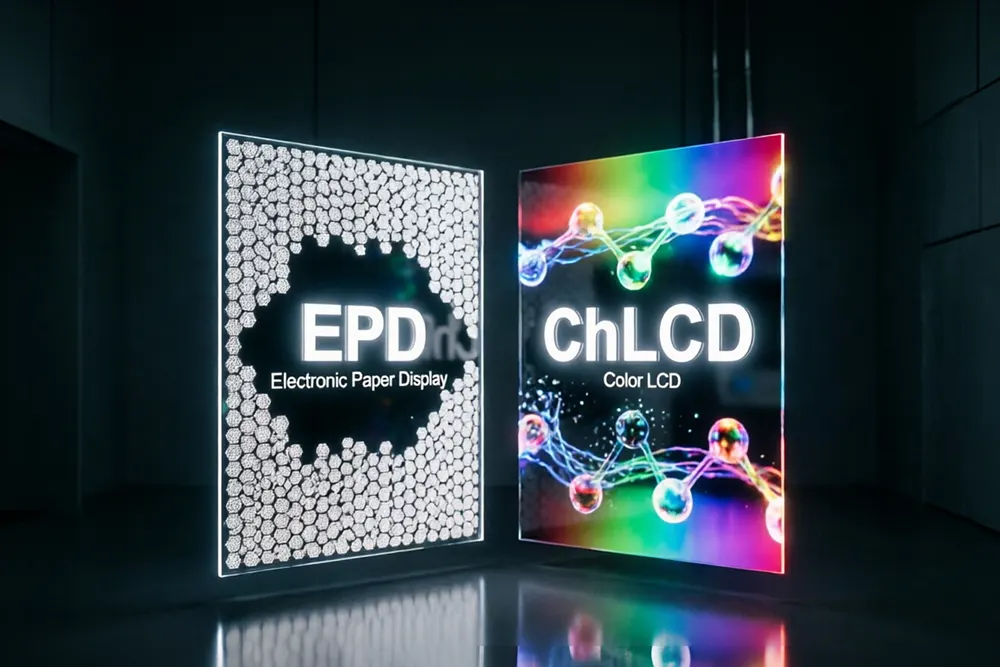
EPD (electrophoretic display) is the more mature, standardized e-paper technology — it’s what powers e-readers, electronic shelf labels, and most color e-paper signage on the market today, including E Ink’s Spectra 6 line. ChLCD (cholesteric liquid crystal display) is a different reflective technology that trades some of EPD’s ecosystem maturity for faster refresh behavior and a wider operating temperature range, which is why it shows up more often in large-format or temperature-exposed signage. Neither is universally better: EPD wins when standardized color performance and supply chain maturity matter most; ChLCD wins when refresh speed and temperature tolerance are the binding constraints.
How Each Technology Works
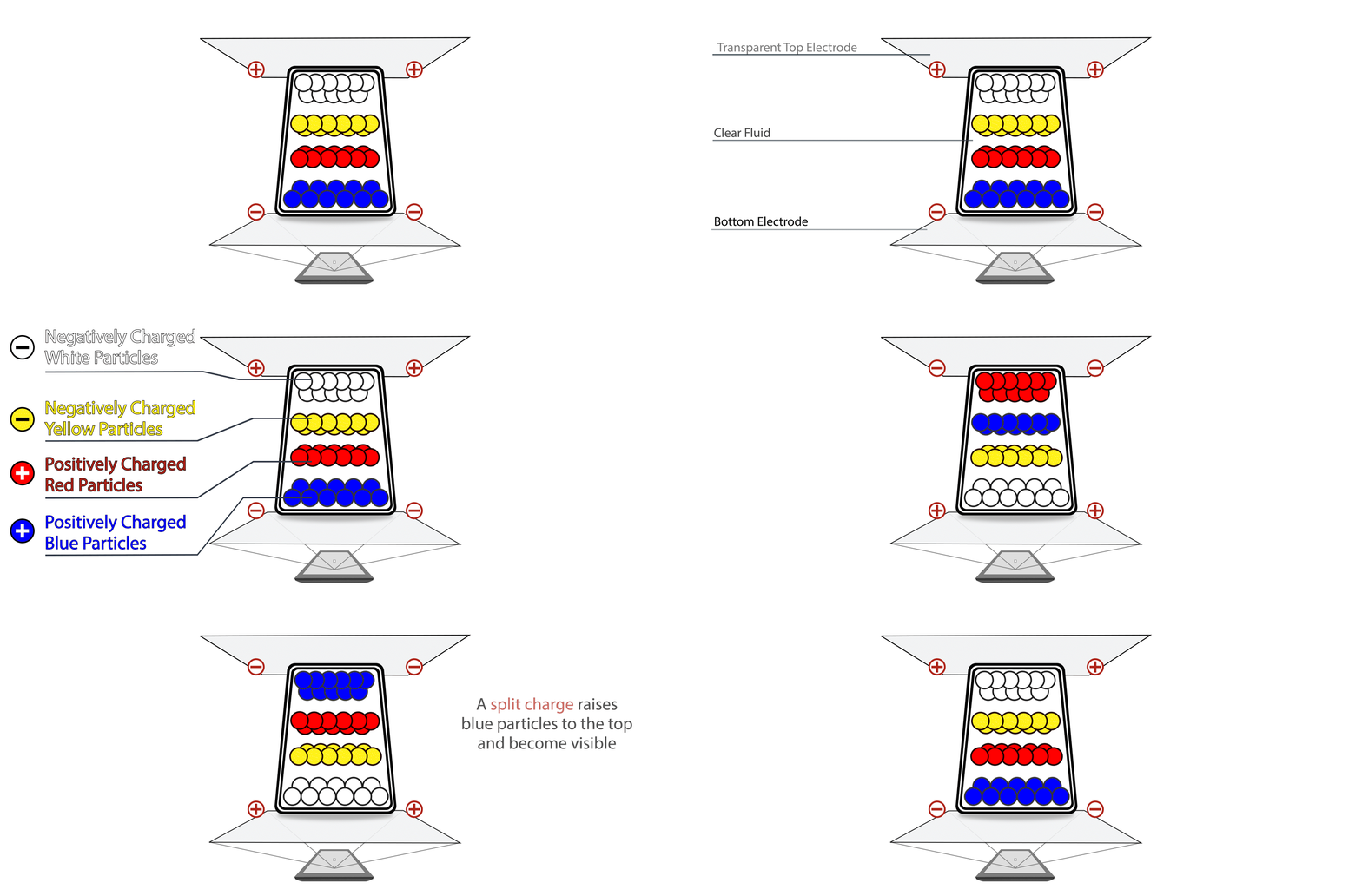
EPD forms images by moving charged pigment particles inside microcapsules. Apply an electric field, and dark or light particles rise to the surface to form a pixel. It’s the technology behind E Ink’s panels, including color lines like Spectra 6, which layer multiple pigment types to extend beyond monochrome.
ChLCD works differently: it uses cholesteric liquid crystal molecules with a naturally helical structure that reflects specific wavelengths of light. Switching between a reflective “planar” state and a light-scattering “focal conic” state — often across stacked red, green, and blue layers — produces the visible image and color.
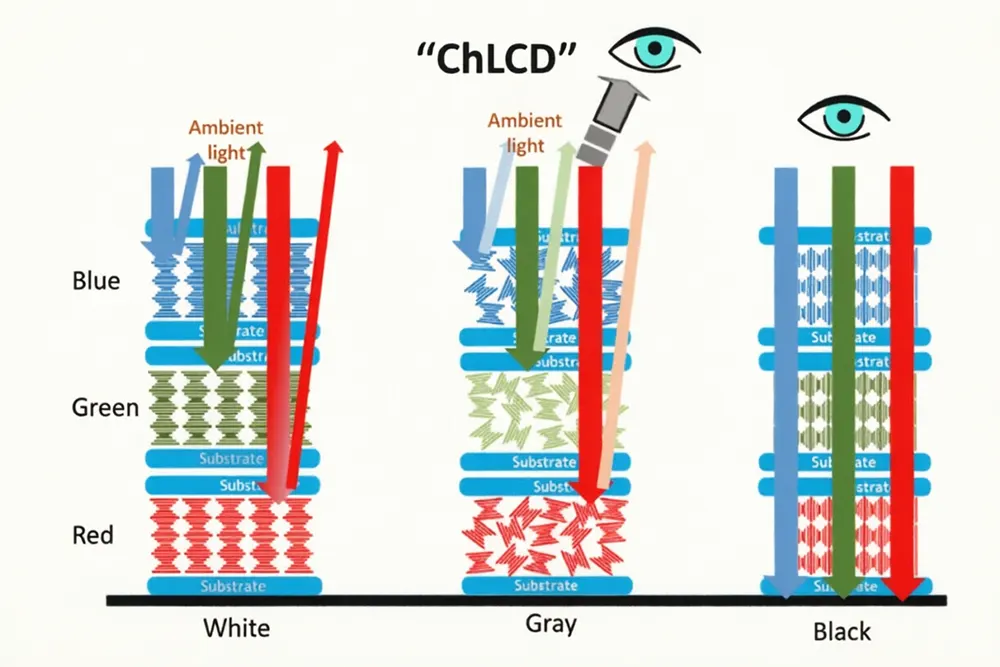
Both are bistable (power is only needed to change the image, not to hold it) and both skip the backlight entirely, which is why they share e-paper’s core low-power, sunlight-readable behavior. The difference is entirely in how each one gets there — and that difference is what drives every trade-off below.
Color: Discrete Pigments vs. Wavelength Reflection
It’s tempting to assume “more mature” automatically means “better color,” but the two technologies actually produce color through different mechanisms with different strengths.
EPD color, including Spectra-class panels, is built from a defined set of pigments — a wider color range than early e-paper, but still a combination of fixed states rather than continuous color. ChLCD generates color through wavelength-selective reflection rather than pigment combinations, which in principle allows more continuous color representation and can look more natural under ambient light — though real-world results depend heavily on implementation quality.
Neither wins outright on color; they arrive at similar-looking results through different physics, and the practical difference shows up more in refresh behavior than in color richness.
Refresh Speed: Why ChLCD Updates Faster
This is where the two technologies genuinely diverge, and it’s usually the deciding factor once color needs are similar.
EPD’s image is formed by physically moving pigment particles — that takes time, and full-screen color updates can take several seconds with a visible transition. ChLCD switches liquid crystal states electrically, which is inherently faster. Neither technology is built for video, but ChLCD tolerates more frequent updates without the visible refresh lag that color EPD shows.
If your content changes multiple times a day rather than once a day, this is the dimension to weigh most heavily — not color quality.
Operating Temperature: Where ChLCD’s Range Matters
This is the trade-off that gets left out of most comparisons, and it matters most for anything deployed outdoors or in unconditioned spaces.
ChLCD generally performs consistently across a wider temperature range, commonly cited around −20°C to 60–70°C, which is why it turns up more often in large-format or semi-outdoor signage. EPD performance, particularly refresh behavior, can be more sensitive to low temperatures — a factor worth checking against your actual deployment environment rather than assuming any e-paper panel behaves the same in a heated retail space and an unconditioned transit shelter.
Cost and Ecosystem Maturity
EPD benefits from a genuinely mature, high-volume supply chain — E Ink’s panels, including Spectra 6, are standardized, widely deployed, and easier to source predictably at scale. ChLCD is a less standardized market: more flexible for custom or large-format designs, but with costs that vary more by implementation, materials, and scale than EPD’s more commoditized pricing.
In practice, this means EPD is usually the lower-risk default for standard sizes and high-volume orders, while ChLCD is often chosen project-by-project, where its temperature range or refresh speed solves a specific problem EPD can’t.
Which One Should You Choose?
| EPD | ChLCD | |
|---|---|---|
| Color mechanism | Pigment particles (discrete states) | Wavelength-selective reflection |
| Refresh speed | Slower, especially in color | Faster |
| Operating temperature | More sensitive at low temps | Wider range (~−20°C to 60–70°C) |
| Ecosystem maturity | Mature, standardized, widely deployed | Less standardized, more project-driven |
| Cost predictability | Stable, high-volume pricing | Varies by implementation |
| Typical fit | E-readers, shelf labels, standard-size color signage | Large-format or temperature-exposed signage |
As a starting rule: if you need a standard panel size, predictable sourcing, and your deployment stays in a normal indoor temperature range, EPD — including color options like Spectra 6 — is the lower-risk choice. If your content updates more than once a day, your signage is large-format, or it sits somewhere temperature swings are a real concern, ChLCD is worth the extra sourcing complexity. MyGica supports both EPD and ChLCD-based e-paper solutions — see the ChLCD solution page and Color E-Paper Display page if you’d like to compare against shipped products rather than a spec sheet.
Frequently Asked Questions
What is the main difference between EPD and ChLCD? EPD forms images by physically moving charged pigment particles; ChLCD forms images by switching the reflective state of liquid crystal layers. That mechanical difference is why ChLCD refreshes faster and tolerates a wider temperature range, while EPD has the more mature, standardized supply chain.
Which is better for outdoor signage, EPD or ChLCD? It depends on the specific conditions. ChLCD’s wider operating temperature range makes it a common choice for large-format or temperature-exposed outdoor signage. EPD, including Spectra 6 color panels, still works outdoors and is often preferred when standardized sizing and sourcing predictability matter more than temperature extremes.
Does ChLCD support color the way E Ink Spectra 6 does? Yes, but through a different mechanism. ChLCD produces color via wavelength-selective reflection, often through stacked RGB layers, while Spectra 6 uses multiple pigment types. Both are viable for color signage; the practical differences show up in refresh speed and ecosystem maturity rather than color quality alone.
Is ChLCD cheaper than EPD? Not consistently. EPD benefits from high-volume, standardized manufacturing, which usually makes cost more predictable. ChLCD costs vary more by implementation and scale, since the market is less standardized — it can be competitive or more expensive depending on the specific design.
If color is the deciding factor in your choice, E Ink Spectra 6 vs. ChLCD goes deeper on that specific trade-off. Still deciding between e-paper and other display categories entirely? E-Ink vs. LCD vs. OLED covers that broader decision first.