
If you’ve settled on color e-paper for your signage or product, you’ll run into this choice fast: E Ink Spectra 6 or ChLCD? Both use reflected ambient light instead of a backlight, both are bistable — meaning they only draw power when the image actually changes — and both get used in the same categories of low-power, sunlight-readable signage. That overlap is exactly why the differences that actually matter (refresh speed, ecosystem maturity, cost predictability) tend to get glossed over when the two are compared.
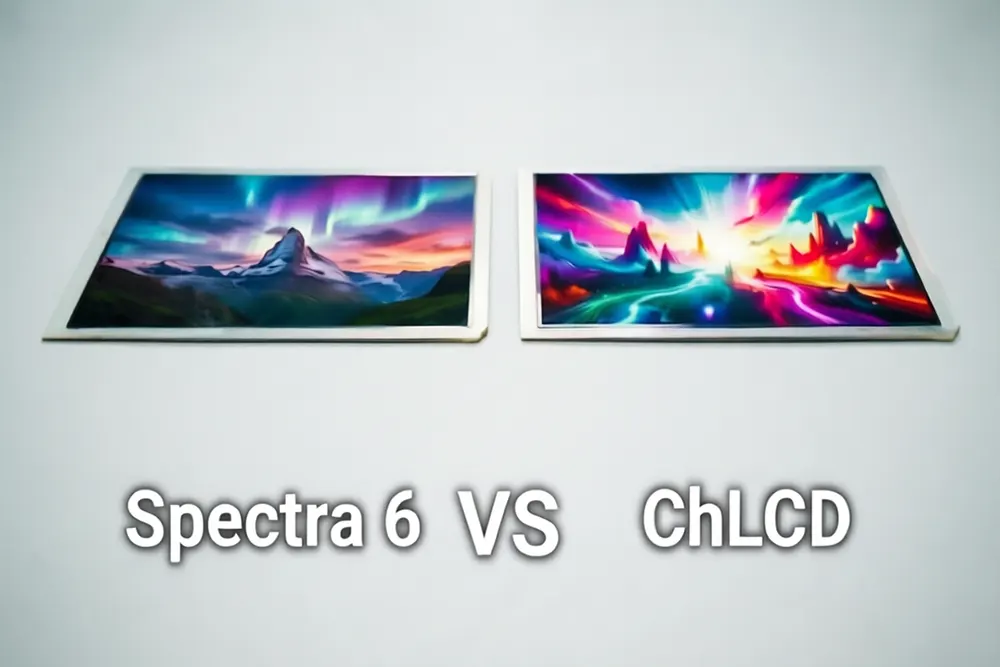
Spectra 6 is the safer default for most projects: standardized panels, a mature supply chain, predictable cost, and it’s already widely deployed in commercial signage. ChLCD is the pick when faster refresh or more flexibility for large or custom-format displays matters more than standardization, and you’re comfortable working with a less mature, more project-driven supply chain. Neither is a straight upgrade over the other — they’re optimized for different priorities.
Spectra 6: How It Works and How It Produces Color
E Ink Spectra 6 is a type of electrophoretic display (EPD). It works by moving tiny charged pigment particles suspended in a liquid.
Each pixel contains microcapsules filled with different colored particles. When an electric field is applied:
- Some particles move to the surface and become visible
- Others move away and disappear from view
- The final image is created by how these particles settle
Once in place, the particles stay there without needing additional power.
Color is produced using a fixed set of pigments. Instead of generating smooth, continuous color like LCD or OLED, Spectra 6 forms images by combining discrete pigment states. Because of this, color gradients are limited and are usually enhanced through driving algorithms and image processing.
ChLCD: How It Works and How It Produces Color
ChLCD is based on cholesteric liquid crystal materials, which naturally form a spiral (helical) molecular structure that reflects light at specific wavelengths.
It operates between two stable states:
- Planar state: reflects specific wavelengths of light, producing visible color
- Focal conic state: scatters light, making the surface appear darker or less reflective
By controlling these states — often by stacking red, green, and blue layers — ChLCD can generate a range of colors through reflected light.
Unlike Spectra 6, there are no moving pigments. Color comes directly from how light interacts with the liquid crystal structure itself.
Key Differences at a Glance
| Dimension | E Ink Spectra 6 | ChLCD |
|---|---|---|
| Display principle | Electrophoretic particle movement | Liquid crystal optical reflection |
| Color generation | Discrete pigment-based states | Wavelength-selective reflection |
| Color behavior | Limited palette, less smooth gradients | More continuous optical response |
| Refresh speed | Slower (particle movement) | Faster (liquid crystal switching) |
| Power consumption | Ultra-low, update-only | Ultra-low, update-only |
| Ecosystem maturity | Mature and widely deployed | Still developing |
| Large-format scalability | Standardized panels | More flexible, less standardized |
| Cost structure | Stable and predictable | Varies by implementation |
| Typical use cases | Signage, transport info, static displays | Large visual displays, signage systems |
Refresh Speed and Responsiveness
The main difference in speed comes from how images are updated.
Spectra 6 relies on physical movement of pigment particles inside a liquid. Since matter is actually moving, updates take time — full-screen refreshes are relatively slow, and transitions are often visible.
ChLCD changes image content by shifting liquid crystal alignment, which is faster than particle movement. Updates are quicker, though ChLCD still isn’t suitable for video or fast animation.
Ecosystem Maturity and Cost
System maturity affects real-world deployment as much as the display technology itself, and it’s also what drives cost — so it’s worth looking at both together.
Spectra 6 benefits from a mature supply chain and stable, predictable pricing thanks to established manufacturing. It’s already widely used in commercial signage and retail systems, with standardized panel sizes that make scaling straightforward.
ChLCD is still in a more fragmented stage of development. It offers more flexibility for large or custom formats, but costs vary more by scale, materials, and implementation approach — there isn’t yet the same standardized, mass-production pricing that Spectra 6 has.
Energy and System Behavior
Both technologies are extremely low-power because they’re bistable — they only consume energy when updating content, and once an image is written, it holds without continuous power.
In practice, Spectra 6 is better suited for infrequent updates and static content, while ChLCD can support slightly more dynamic update patterns depending on system design.
Application Scenarios
Spectra 6 is mainly used in color reflective signage where visual communication matters more than frequent updates: retail digital signage and brand displays, transportation and public information systems (limited color use), smart city signage, and static or semi-static advertising displays.
It is not the main technology for traditional electronic shelf labels (ESL), which are still dominated by monochrome or low-color EPD systems due to cost and update frequency requirements. Spectra 6 is better seen as an extension of e-paper into color signage, rather than an ESL replacement.
ChLCD is typically used in specialized reflective display applications where optical performance and environmental flexibility matter: outdoor and semi-outdoor signage, large-format reflective display panels, retail promotional displays, and environmental or public information systems. Its adoption is usually project-driven rather than mass-standardized deployment.
Which One Should You Choose?
If you need a standard panel size, predictable cost, and a supply chain that scales without custom engineering, Spectra 6 is the lower-risk choice — it’s why it’s already the more widely deployed of the two in commercial signage. If your project needs faster refresh, a large or non-standard format, or more design flexibility than a standardized panel allows, ChLCD is worth the extra sourcing complexity. For OEM projects, panel selection is only one part of the system design. Controller integration, firmware optimization, enclosure design, and long-term supply planning also influence the final solution. MyGica provides E Ink Spectra 6 solutions for customers evaluating color signage deployments.
Frequently Asked Questions
Is E Ink Spectra 6 better than ChLCD? Not universally — they optimize for different things. Spectra 6 offers a more mature, standardized, and cost-predictable option; ChLCD offers faster refresh and more flexibility for large or custom formats. The better choice depends on which of those matters more for your project.
Can either technology display video or fast-moving content? No. Both are designed for static or slowly-changing content. ChLCD refreshes faster than Spectra 6, but neither is suitable for video or fast animation.
Which is more cost-effective at scale? Spectra 6 generally has more predictable, stable pricing due to its mature, standardized manufacturing. ChLCD costs vary more by implementation, scale, and materials, since the supply chain is less standardized.
Is Spectra 6 used for electronic shelf labels (ESL)? Not typically. ESL systems are still dominated by monochrome or low-color EPD due to cost and update-frequency requirements. Spectra 6 is better suited to color signage applications than to shelf-label replacement.
Is this the same as comparing EPD vs. ChLCD in general? Not quite — Spectra 6 is one specific color EPD technology, not EPD as a whole. If you’re deciding between EPD and ChLCD more broadly (including monochrome options), EPD vs. ChLCD covers that wider comparison.
Conclusion
E Ink Spectra 6 and ChLCD take very different approaches to color reflective displays. Spectra 6 uses moving pigment particles; ChLCD relies on light reflection through liquid crystal structures. Both are low-power, bistable technologies designed for static or semi-static content, and in practice they often overlap in applications like digital signage. The differences come down to how they generate color, how fast they update, and how mature their ecosystems are — not simply which one performs “better.”