
Off-grid public transit displays are becoming increasingly attractive where electrical infrastructure is expensive to install, historic districts restrict trenching for new cabling, or transit agencies are pursuing lower operating costs and broader sustainability goals. This project is a real example of what that looks like in practice.
A public transit authority in Germany needed to modernize bus stop information across its network without installing new electrical wiring or fixed network infrastructure. The project ultimately involved around 200 e-paper displays deployed across bus stops and vehicles, replacing a mix of paper timetables and aging LCD/LED signage.
The Brief
The requirements were direct, even where the client didn’t spell out every reason behind them: fully off-grid power via a small solar panel mounted on top of each sign, and 4G/5G connectivity to pull real-time vehicle GPS data and predict arrival times — with no dependence on wired power or a fixed network connection at any stop. In practice, that kind of requirement usually shows up for a mix of reasons — carbon and energy goals, the cost of running electrical infrastructure to every stop, restrictions on digging up streets in older districts, or simply the long-term cost of maintaining wired signage — but the client’s brief itself was about the outcome, not the justification.
What that meant for the hardware: no assumptions about existing power or network access at any install location, and a display technology that could hold a legible image indefinitely without drawing continuous power to do it.
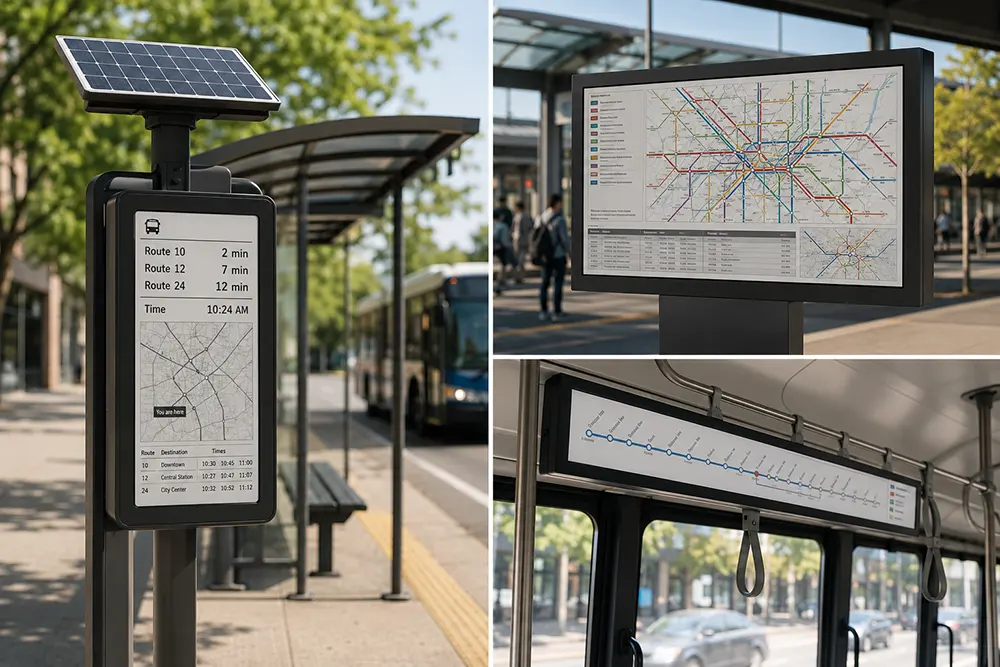
Three Display Formats, Matched to Where They’re Used
MyGica supplied 200 units across three configurations, each matched to a specific role in the deployment:
- 13.3″ monochrome e-paper bus stop signs, deployed at most standard stops, showing real-time arrival countdowns, route and stop maps, and timetables.
- 31.5″ full-color e-paper signage, used at larger interchanges and hub stops where the route map itself needs color to distinguish between multiple overlapping lines clearly.
- 28″ bar-format (strip) e-paper displays for in-vehicle use, typically mounted above the handrails, above the doors, or behind the driver’s seat, replacing the printed paper or plastic route maps previously used on board.
The two stop-sign formats run on the same off-grid architecture: a compact rooftop-mounted solar panel keeps each unit charged, and 4G/5G connectivity pulls live GPS-based arrival predictions directly from the transit authority’s own systems, without requiring any new fixed network infrastructure to be run to the stop itself. The in-vehicle strip displays, powered from the vehicle itself, show a dynamic, always-current route map with live progress toward the next stop, along with rider-assistance information such as transfer connections — content that used to be static and printed, now live and centrally updated.
The Engineering Problem: A Display That’s 99% Static and 1% Urgent
The actual technical challenge sits at the stop-sign level. On a typical sign, the arrival countdown updates roughly every minute — everything else (route number, stop name, timetable) stays exactly the same for hours. A standard refresh approach forces a choice: flash the entire sign on every countdown update (wasteful, and looks unpolished for something updating this often), or limit updates to a single rectangular region, which doesn’t map cleanly onto how these layouts are actually designed.
MyGica’s custom TCON architecture handles this with arbitrary-shape partial refresh — updating only the specific, non-rectangular region showing the countdown digits, while everything else on the sign stays completely untouched on every update. As far as we’re aware, this is among the first real-world deployments of non-rectangular partial refresh at this scale in transit signage specifically. In testing on this platform, the approach held flicker under 4Hz and ghosting under 0.8%, with local power consumption reduced by more than 40% compared to a full-refresh approach — which matters directly here, since every milliwatt saved on refresh is a milliwatt less the solar panel and battery need to replenish. (Full technical breakdown in our piece on how this TCON architecture works.)
Content and Integration: Hardware and SDK, Not a Managed Platform
One detail worth being specific about: MyGica didn’t build or operate the content running on these displays. All of it — GPS-based predictions, route data, transfer information — is managed entirely by the client’s own backend systems. MyGica’s role was the hardware, plus an open SDK and API built to integrate with whatever’s already running on the client’s side — an existing AVL (automatic vehicle location) system, a passenger information system (PIS), or a custom-built transit platform — rather than a proprietary content platform MyGica hosts or manages on their behalf. That’s the same firmware/integration layer we cover more generally in our guide to what’s customizable on an e-paper display — for a client with its own backend and GPS infrastructure already built, hardware-plus-SDK is often a better fit than a fully managed platform.
Takeaways for Similar Projects
A few things from this project generalize to other off-grid or transit signage work:
- Off-grid isn’t just “add a solar panel.” It changes what refresh behavior can afford to look like — which is why the partial-refresh engineering mattered as much as the solar hardware itself.
- Matching signage tier to stop complexity (monochrome for standard stops, color for complex interchange maps) keeps cost proportional to actual need, rather than over-specifying every stop to the hardest case.
- Hardware-plus-SDK isn’t the right fit for every client — it works well when the client already has the backend and data infrastructure to integrate against, as this one did.
FAQ
What does “arbitrary-shape partial refresh” mean in practice?
Standard partial refresh typically updates a single rectangular region of a display. Arbitrary-shape partial refresh can update an irregularly shaped region — such as just the digits of an arrival countdown — without redrawing anything outside that shape, reducing power draw and avoiding unnecessary flicker on the surrounding static content.
Can bus stop signage really run entirely on solar and battery power?
Yes, when the display technology’s baseline power draw is low enough — e-paper’s bistable design (power used only when content changes) makes this practical in a way it typically isn’t for backlit LCD or LED signage at the same scale.
Does MyGica provide the content management platform for deployments like this?
Not always — in this project, the client integrated their own GPS and route data directly using MyGica’s SDK and API, rather than using a MyGica-hosted content platform. Which approach fits depends on whether a client already has their own backend infrastructure to integrate against.